

[ICPC 2016 NAIPC] Tourists
题目描述
In Tree City, there are tourist attractions uniquely labeled to . The attractions are connected by a set of bidirectional roads in such a way that a tourist can get from any attraction to any other using some path of roads.
You are a member of the Tree City planning committee. After much research into tourism, your committee has discovered a very interesting fact about tourists: they LOVE number theory! A tourist who visits an attraction with label will then visit another attraction with label if and is a multiple of . Moreover, if the two attractions are not directly connected by a road the tourist will necessarily visit all of the attractions on the path connecting and , even if they aren’t multiples of . The number of attractions visited includes and themselves. Call this the length of a path.
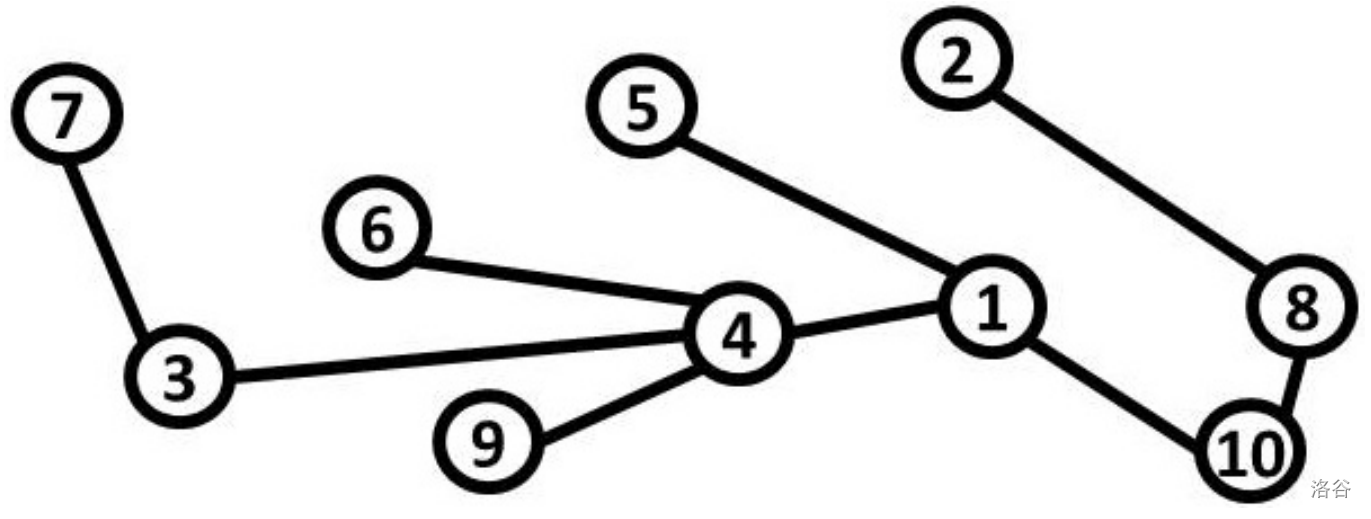
Consider this city map:
:::align{center}
 :::
:::
Here are all the paths that tourists might take, with the lengths for each:
, , , , , ,
, , , , , ,
, , , ,
To take advantage of this phenomenon of tourist behavior, the committee would like to determine the number of attractions on paths from an attraction to an attraction such that and is a multiple of . You are to compute the sum of the lengths of all such paths. For the example above, this is: $4 + 3 + 2 + 2 + 3 + 4 + 3 + 3 + 2 + 5 + 6 + 2 + 3 + 3 + 3 + 4 + 3 = 55$.
输入格式
Each input will consist of a single test case. Note that your program may be run multiple times on different inputs. The first line of input will consist of an integer () indicating the number of attractions. Each of the following lines will consist of a pair of space-separated integers and (), denoting that attraction and attraction are directly connected by a road. It is guaranteed that the set of attractions is connected.
输出格式
Output a single integer, which is the sum of the lengths of all paths between two attractions and such that and is a multiple of .
10
3 4
3 7
1 4
4 6
1 10
8 10
2 8
1 5
4 9
55